Saturday, February 8, 2014

God's Own Country

The tour which we planned a night before and executed next day. 
With my Bro's Sudhakaran, Ashok & Vinu.


With by Bro's at Munnar.


Hospital at Valparai where my sister working, which is opposite to my sister's home.


Its one type of MALLI. I don't know the apt English name for this.


Clicked at Valparai


Getting down from Munnar and heading towards Topslip, Tamilnadu. This is a view point near Pollachi. Remarkable scenery which we never expected this pic upto this level. Thanks to Vinu captured by a Nikon Camera.


This is at Parambikulam reserve forest under the control of Kerala Government. Photo credits goes to Vinu.


 JUNGLE SAFARI in VAN
Its at Topslip, Tamilnadu government vechicle which carries us into the forest. Its not that much to Parambikulam reserve forest.


With my Bro Vinu at Parambikulam Dam


At Forest!!!


Monday, June 24, 2013

John Deere reveals a 4.5l Tier4f engine without DPF


John Deere reveals a 4.5l Tier4f engine without DPF
1


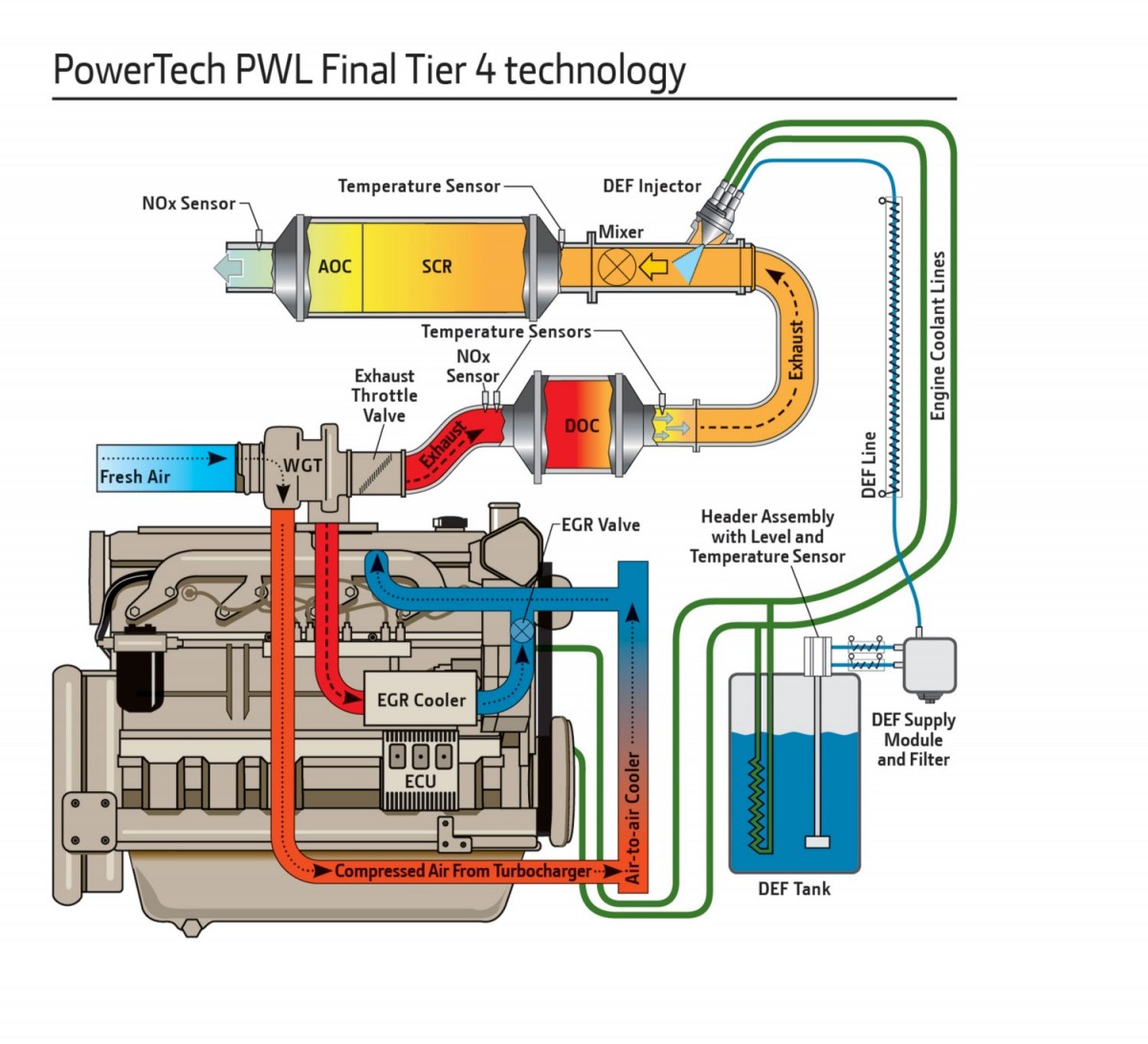
John Deere Power Systems introduced recently the PowerTech™ PWL 4.5L engine, which will meet Final Tier 4/Stage IV emissions regulations without a diesel particulate filter (DPF). The 63 kW to 104 kW (85 hp to 140 hp) engine was announced at Bauma 2013 in Munich, and complements the John Deere lineup of Final Tier 4/Stage IV off-highway diesel engines rated 36 kW to 448 kW (48 hp to 600 hp) announced earlier.
The PowerTech PWL 4.5L engine reduces cost and improves engine packaging by eliminating the DPF — while still meeting customer performance expectations for applications in the 56 kW to 104 kW (75 hp to 140 hp) power segment.
The PowerTech PWL 4.5L is equipped with an Integrated Emissions Control system consisting of selective catalytic reduction (SCR), a diesel oxidation catalyst (DOC) and cooled exhaust gas recirculation (EGR) technology. Elimination of the DPF was enabled through combustion system optimization and improvements in SCR system conversion efficiency.
“We believe the elimination of the DPF will serve OEMs and end users well in the very competitive 56 kW to 104 kW (75 hp to 140 hp) segment, balancing packaging and product cost considerations with performance and operating cost requirements,” said John Piasecki, director of marketing, sales and customer support for John Deere Power Systems. “We expect emissions technologies will continue to evolve and improve, and we’ll adopt those changes when available to improve the customer experience.”
The introduction of the PowerTech PWL 4.5L engine represents the third Integrated Emissions Control system configuration John Deere will offer for Final Tier 4/Stage IV.
For the 36 kW to 55 kW (48 hp to 74 hp) power range, John Deere will offer models using a DOC/DPF without cooled EGR or SCR. The PowerTech PWL 4.5L in the 56 kW to 104 kW (75 hp to 140 hp) power range will be equipped with an Integrated Emissions Control system configured with SCR, a DOC and cooled EGR. Engine models above 104 kW (140 hp) will feature an Integrated Emissions Control system consisting of cooled EGR, a DOC/DPF and SCR. All John Deere Integrated Emissions Control systems are exclusively designed to meet the specific demands of off-highway applications in the given power categories.
powertech PWL engineTier4f
“At John Deere, we tailor our Integrated Emissions Control system configurations to meet customer needs and Final Tier 4/Stage IV emissions regulations,” Piasecki said. “We’re confident that all of our solutions will deliver industry leading performance and value while also meeting required long term emissions compliance.”
With the move to SCR technology for Final Tier 4/Stage IV engines, total fluid economy becomes important, and John Deere is confident that its total fluid operating costs will grow its industry leadership. Total fluid economy takes into account an engine’s total fluid consumption, including diesel fuel and diesel exhaust fluid (DEF). DEF consumption with John Deere Final Tier 4/Stage IV engines will be 1 to 4 percent of diesel fuel consumption depending on the application. Low DEF consumption also means:
  1. the DEF tank size can be smaller, minimizing space required on vehicles
  2. extended DEF filter service intervals
  3. less on-site bulk storage requirements
John Deere Final Tier 4/Stage IV engines will provide the same or higher levels of power density and transient response as the Interim Tier 4/Stage III B product lineup.
Models and power ratings for the full John Deere Final Tier 4/Stage IV lineup include:
  • PowerTech EWX 2.9L: 36 kW – 55 kW (48 hp – 74 hp)
  • PowerTech EWX 4.5L: 55 kW (74 hp)
  • PowerTech PWL 4.5L: 63 kW – 104 kW (85 hp – 140 hp)
  • PowerTech PSS 4.5L: 93 kW – 129 kW (125 hp – 173 hp)
  • PowerTech PVS 6.8L: 104 kW – 187 kW (140 hp – 250 hp)
  • PowerTech PSS 6.8L: 168 kW – 224 kW (225 hp – 300 hp)
  • PowerTech PSS 9.0L: 187 kW – 317 kW (250 hp – 425 hp)
  • PowerTech PSS 13.5L: 309 kW – 448 kW (414 hp – 600 hp)
Source: John Deere

Sunday, June 23, 2013

A twin-scroll turbocharger for the Hyundai 1.6l Turbo-GDI engine


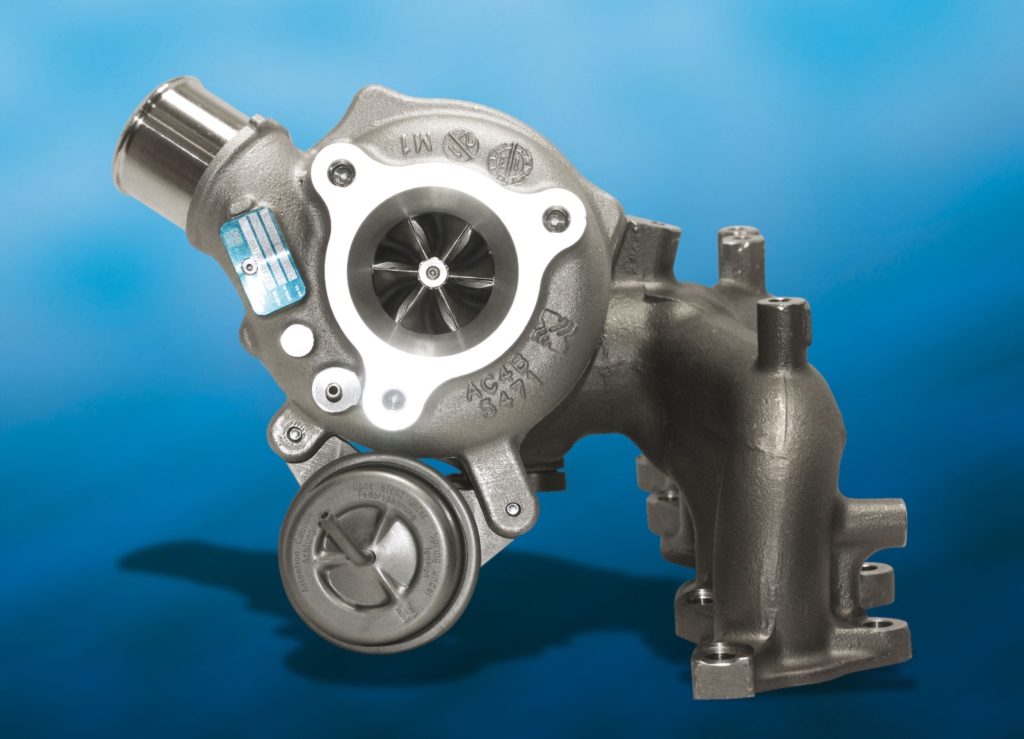
BorgWarner supplies its turbocharging technology for Hyundai’s new 1.6-liter turbocharged gasoline direct injection (T-GDI) engine. Available for the Veloster Turbo passenger car, the turbocharged engine features a maximum output of 150 kW (204 hp), an increase of 46 percent compared with Hyundai’s standard 1.6-liter GDI engine. The Veloster Turbo has also been available in Europe since October 2012.
“Combined with Hyundai’s direct-injection technology, BorgWarner’s turbocharging expertise helps achieve a fuel efficient and responsive engine for an exhilarating driving experience,” said Frederic Lissalde, President and General Manager, BorgWarner Turbo Systems. “We are very pleased to expand our successful relationship with Hyundai Motor Company through our supply of advanced turbocharging technology for gasoline engines.”
BORGWARNER HYUNDAI 1.6l gasoline direct injection engine

To develop a state-of-the-art engine featuring low-end torque, responsiveness, instantaneous power delivery and improved fuel economy, Hyundai matched BorgWarner’s K03 twin scroll turbocharging technology with its GDI system. Compared with a single scroll turbocharger, twin scroll turbocharging recovers more energy from the exhaust gas and improves responsiveness even at low rpm. BorgWarner’s twin scroll turbocharger separates the exhaust gases of the cylinders and minimizes parasitic back pressures. BorgWarner further optimizes the exhaust gas flow to the turbine wheel with an optimized channel design. Torque of 270 Nm is available over a wide engine speed range, from 1,750 rpm and up to 4,500 rpm. In addition, BorgWarner integrated the exhaust manifold into the stainless steel turbine housing to reduce size and weight while optimizing heat energy recovery for better efficiency.
Source: BorgWarner


Sunday, May 8, 2011

Moon Microbe Mystery Finally Solved


There has been a long-lived bit of Apollo moon landing folklore that now appears to be a dead-end affair: microbes on the moon.  
The lunar mystery swirls around the Apollo 12 moon landing and the return to Earth by moonwalkers of a camera that was part of an early NASA robotic lander – the Surveyor 3 probe.
On Nov. 19, 1969, Apollo 12 astronauts Pete Conrad and Alan Bean made a precision landing on the lunar surface in Oceanus Procellarum, Latin for the Ocean of Storms. Their touchdown point was a mere 535 feet (163 meters) from the Surveyor 3 lander -- and an easy stroll to the hardware that had soft-landed on the lunar terrain years before, on April 20, 1967. [Video: Apollo 12 Visits Surveyor 3 Probe]
The Surveyor 3 camera was easy pickings and brought back to Earth under sterile conditions by the Apollo 12 crew. When scientists analyzed the parts in a clean room, they found evidence of microorganisms inside the camera.
In short, a small colony of common bacteria -- Streptococcus Mitis -- had stowed away on the device.
The astrobiological upshot as deduced from the unplanned experiment was that 50 to 100 of the microbes appeared to have survived launch, the harsh vacuum of space, three years of exposure to the moon's radiation environment, the lunar deep-freeze at an average temperature of minus 253 degrees Celsius, not to mention no access to nutrients, water or an energy source. [Photos: Our Changing Moon]
Now, fast forward to today.
NASA's dirty little secret?
A diligent team of researchers is now digging back into historical documents -- and even located and reviewed NASA's archived Apollo-era 16 millimeter film -- to come clean on the story.
As it turns out, there's a dirty little secret that has come to light about clean room etiquette at the time the Surveyor 3 camera was scrutinized.
"The claim that a microbe survived 2.5 years on the moon was flimsy, at best, even by the standards of the time," said John Rummel, chairman of the Committee on Space Research (COSPAR) Panel on Planetary Protection. "The claim never passed peer review, yet has persisted in the press -- and on the Internet -- ever since." [Coolest New Moon Discoveries]
The Surveyor 3 camera-team thought they had detected a microbe that had lived on the moon for all those years, "but they only detected their own contamination," Rummel told SPACE.com.
A former NASA planetary protection officer, Rummel is now with the Institute for Coastal Science & Policy at East Carolina University in Greenville, N.C.
Rummel, along with colleaguesJudith Allton of NASA’s Johnson Space Center and Don Morrison, a former space agency lunar receiving laboratory scientist, recently presented their co-authored paper: "A Microbe on the Moon? Surveyor III and Lessons Learned for Future Sample Return Missions."
Poor space probe hygiene
Their verdict was given at a meeting on "The Importance of Solar System Sample Return Missions to the Future of Planetary Science," in March at The Woodlands,Texas, sponsored by the NASA Planetary Science Division and Lunar and Planetary Institute.
"If 'American Idol' judged microbiology, those guys would have been out in an early round," the research team writes of the way the Surveyor 3 camera team studied the equipment here on Earth. Or put more delicately, "The general scene does not lend a lot of confidence in the proposition thatcontamination did not occur," co-author Morrison said.
For example, participants studying the camera were found to be wearing short-sleeve scrubs, thus arms were exposed. Also, the scrub shirt tails were higher than the flow bench level … and would act as a bellows for particulates from inside the shirt, reports co-author Allton.
Other contamination control issues were flagged by the researchers.
In simple microbiology 101 speak, "a close personal relationship with the subject ... is not necessarily a good thing," the research team explains.
All in all, the likelihood that contamination occurred during sampling of the Surveyor 3 camera was shown to be very real.
A cautionary tale
On one hand, Rummel emphasized that today’s methods for handling return samples are much more effective at detecting microbes.
However, the Surveyor 3 incident back then raises a cautionary flag for the future.
"We need to be orders of magnitude more careful about contamination control than was the Surveyor 3 camera-team. If we aren't, samples from Mars could be drowned in Earth life upon return, and in all of that 'noise' we might never have the ability to detect Mars life we may have brought back, too," Rummel said. "We can, and we must, do a better job with a Mars sample return mission."
Winner of this year's National Space Club Press Award, Leonard David has been reporting on the space industry for more than five decades. He is past editor-in-chief of the National Space Society's Ad Astra and Space World magazines and has written for SPACE.com since 1999.

Sunday, May 1, 2011

Sunday, January 2, 2011

Wednesday, July 14, 2010

Friday, February 26, 2010

Top 5 Fastest Cars in the World


Here is the definitive list of the top 5 Fastest Cars in the World! Truly Amazing pieces of engineering, pushing performance to its limits! Relish in the power of the SSC Ultimate Aero, Bugatti Veyron, Koenigsegg CCX, Saleen S7 Twin-Turbo & the Mclaren F1!

Rank 1. SSC Ultimate Aero


The SSC Aero is an American-built mid-engine sports car by Shelby Super Cars. Its higher-performance limited production version, the SSC Ultimate Aero TT, is currently the fastest production car in the world, with a fastest recorded speed of 413 km/h (257 mph).This speed was reportedly achieved during tests on September 13, 2007 in West Richland, Washington, United States and verified by Guinness World Records on October 9, 2007.

The Aero and the Shelby Super Cars company are the brainchildren of Jerod Shelby, who spent over seven years designing the car. The basic Aero model is no longer produced, while, as of 2008, the Ultimate Aero costs about 620,000 dollars.


Rank 2. Bugatti Veyron


The Bugatti Veyron 16.4 is a mid-engine sports car produced by Volkswagen Group subsidiary Bugatti Automobiles SAS introduced in 2005. It is currently the fastest accelerating and decelerating production car in the world. It is currently also the most expensive production car available at a price of 1.1 million Euro. It is able to achieve the second highest top speed for a production car, behind the SSC Ultimate Aero TT .

Powered by a 736-kilowatt (1,001 PS/987 hp) W16 engine, it is able to achieve an average top speed of 408.47 km/h (253.81 mph). The car reached full production in September 2005, and is handcrafted in a factory Volkswagen built near the former Bugatti headquarters in Château St Jean in Molsheim (Alsace, France). It is named after French racing driver Pierre Veyron, who won the 24 hours of Le Mans in 1939 while racing for the original Bugatti firm. Two examples of the Veyron are known to have been wrecked since production began.

Rank 3. Koenigsegg CCX


The Koenigsegg CCX is a mid-engined roadster from Swedish car manufacturer Koenigsegg. The CCX has been engineered to comply with the US regulation and market demands and is an evolutionary design that replaced the Koenigsegg CCR. CCX is an abbreviation for Competition Coupe X; the X commemorating the 10th anniversary, (being the Roman numeral for ten), of the completion and test drive of the first CC vehicle in 1996.

The CCX was first unveiled on February 28, 2006 at the 2006 Geneva Motor Show although its existence was announced earlier. A derivative known as the CCXR is available, the difference being that CCXR's engine is tuned to run on biofuel. The different fuel and tune allows the CCXR to produce 25% more power than the CCX.

Rank 4. Saleen S7 Twin-Turbo


The Saleen S7 is a limited production, hand built high-performance automobile developed jointly by Saleen, Hidden Creek Industries, Phil Frank Design, and Ray Mallock Ltd. with RML taking full credit designing and developing the S7 and produced solely by Saleen in Irvine, California. It is the first car produced by Saleen not based on an existing design. The S7 debuted on August 19, 2000 at the Monterey Historic Races. From 2000 until 2004, the S7 featured a naturally aspirated V8 engine with 550 horsepower. In 2005, the S7 was replaced by the S7 Twin Turbo, which featured a more powerful twin-turbo system that boosted engine power to 750 horsepower (760 PS/559 kW) and the top speed to an estimated 250 mph (402 km/h).


Rank 5. McLaren F1


The McLaren F1 was formerly the fastest street legal production car in the world, holding this record from 1994 to 2005, the longest period the record has been held by any street legal or production car in the history of automobiles. It was engineered and produced by McLaren Automotive, a subsidiary of the British McLaren Group that, among others, owns the McLaren Mercedes Formula One team. Today, it is still the fastest naturally aspirated car in the world.

The McLaren F1 was at the time the fastest production car ever built, eclipsing the Jaguar XJ220. A standard version of the McLaren achieved a top speed of 371 km/h (231 mph) in 1994, holding this record for more than 10 years until it was finally eclipsed in 2005 by the Koenigsegg CCR.


Rank 6. Ferrari Enzo


The Enzo Ferrari is a 12-cylinder mid-engine berlinetta named after the company's founder, Enzo Ferrari. It is currently one of the most powerful naturally aspirated production car in the world. It was built in 2003 using Formula One technology, such as a carbon-fibre body, F1-style sequential shift transmission, and carbon-ceramic brake discs. Also used are technologies not allowed in F1 such as active aerodynamics and traction control. After a downforce of 775 kg (1709 lb) is reached at 300 km/h (186 mph) the rear wing is actuated by computer to maintain that downforce.

Tuesday, February 23, 2010

The Hydrogen Engine

The Hydrogen Engine


There are two ways for automobile engines to utilize hydrogen fuel. The first is a Hydrogen Internal Combustion Engine or HICE. With HICE, hydrogen is injected directly into the combustion chamber and burnt as part of the fuel mixture. With slight modifications, many existing gasoline engines can be converted to run directly on hydrogen.

Another method of using hydrogen is through a fuel cell. With this method, hydrogen and oxygen is injected into a chamber where it reacts with a catalyst to produce electricity. They are very efficient and small fuel cells produce enough electricity to power electric cars. However fuel cells are very expensive to build.

A Hydrogen Fuel Cell produces electricity to power electric cars. An Internal Combustion Hydrogen Engine burns hydrogen directly.

Hydrogen Powered Engines - Development History

The first inventor of the hydrogen engine was Reverend W. Cecil James in 1820. His engine worked in a similar fashion as the steam engine, where he had used hydrogen to drive a piston. Although his design ran satisfactorily with a recorded revolution of 60 cycles per minute, but the explosions caused considerable noise. Forty years later, by 1860, many other gas engines had been developed by other inventors. Some of them had strange designs including double-acting versions where fuel was combusted on both sides of the piston. However none of them had any real commercial success with the main drawback being the excessive gas consumption.

With the discovery of gasoline in the 1860s and the invention of the carburetor in 1893, brought with it a new breakthrough in engineering. Gasoline engines could now be used both practically and safely, causing interest in other fuels to subside.

It was not until the 20th century that interest in hydrogen was again rekindled. It had found many uses including hydrogen filled airships, the hydrogen bomb, experimental hydrogen powered aircraft, and used most extensively in the rocket space program as rocket fuel.

In recent years, however, interest in hydrogen energy peaked at a feverish rate as concern for cleaner air and global warming fueled the search for an alternative energy source to replace fossil fuels. Various car manufacturers took to the challenge and began research and development of hydrogen powered cars.

The early 1990s saw the arrival of the Shelby Cobra, a freelance vehicle conversion project from gasoline to hydrogen power. Other more renowned car manufacturers such as Honda introduced their first prototype, the Honda FCX in 1999. A few years later in 2002, Mercedes Benz introduced their first generation of fuel cell vehicles. By 2004, Peugeot had joined this elite group and at the same time BMW’s Hydrogen Powered program produced the first breed of racecars to run on liquid hydrogen.

A 1965 Ford Shelby Cobra Hydrogen Powered BMW H2R

Today, hydrogen powered prototypes and concept cars are being developed by Honda, Toyota, Nissan, Volkswagen, Hyundai, Audi, BMW, Mercedes Benz, Fiat, General Motors, Ford, Peugeot, Chrysler and other less prominent manufacturers. Many are approaching commercial viability such as Honda to begin limited marketing of their latest fuel cell vehicle in 2008. General Motors has stated that it can produce a commercially viable model by 2010.

Everyone love this